Nassau County Dog Registration Information
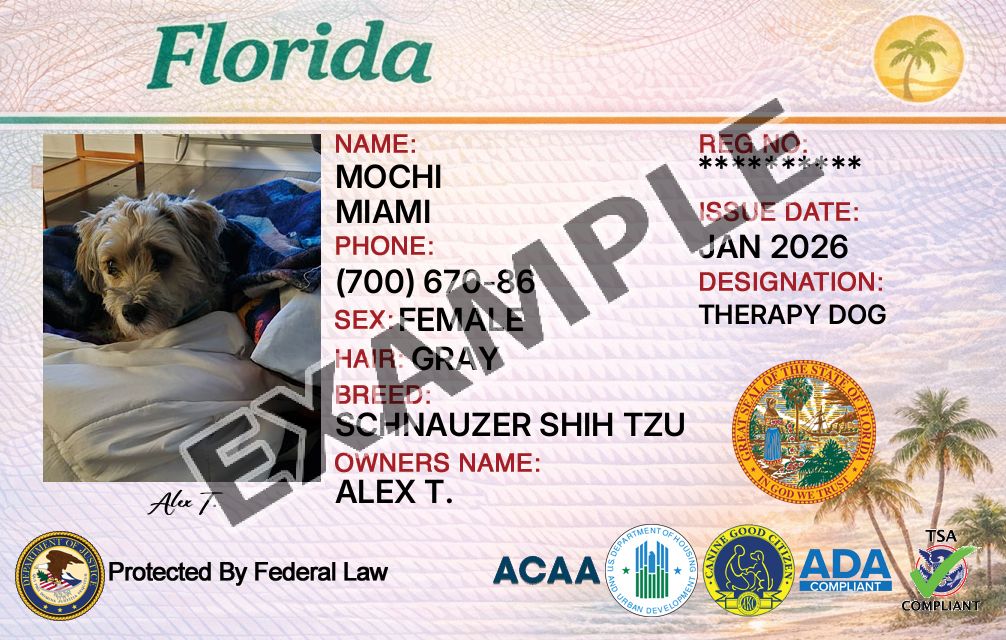
Service Dogs and Emotional Support Animals in Nassau, Florida
If you’re asking, “where do I register my dog in Nassau County, Florida for my service dog or emotional support dog?” the most important thing to know is that “registration” usually means a local dog license (sometimes tied to a rabies tag) issued by a county or city program—not a special federal service-dog registry.
In Nassau County, dog licensing and rabies enforcement are handled through local government animal services and, in some areas, city animal services. This page explains how the dog license in Nassau County, Florida process typically works, what rabies proof is required, and how licensing differs from the legal status of a service dog or an emotional support animal (ESA).
- A local animal control dog license Nassau County, Florida requirement may apply to all dogs (including service dogs and emotional support dogs), because it’s about rabies control and identification.
- The ADA does not require service dogs to be registered and businesses generally cannot require proof of “certification” or a registry ID card for public access. They may only ask limited questions when it’s not obvious what the dog does.
- Emotional support animals are generally treated differently than service dogs and do not have the same public-access rights under the ADA. ESAs are primarily a housing-related accommodation topic under federal fair housing rules.
Where to Register or License Your Dog in Nassau County, Florida
Because licensing is often handled locally, the best place to start is the official animal services or city animal services office that serves your address. Below are example official offices in Nassau County, Florida that residents commonly contact for where to register a dog in Nassau County, Florida questions.
Nassau County Animal Control (Nassau County Animal Services)
- Tuesday, Thursday, Friday: 11:00 AM – 4:00 PM
- Wednesday: 1:00 PM – 6:00 PM
- Saturday & Sunday: 11:00 AM – 4:00 PM
- Closed to the public on Mondays
This is the primary county-level contact for animal control and general licensing/rabies enforcement questions in unincorporated Nassau County and other areas served by the county.
City of Fernandina Beach — Animal Services (operated by Nassau Humane Society)
- Tuesday – Thursday: 11:00 AM – 5:00 PM
- Friday: 11:00 AM – 6:00 PM
- Saturday & Sunday: 11:00 AM – 4:00 PM
If your home is inside Fernandina Beach city limits, the city requires pet licensing and provides animal services through this office. Bring proof of a current rabies certificate administered by a veterinarian.
The right licensing office depends on whether your address is in an incorporated city (such as Fernandina Beach) or in an unincorporated area of Nassau County. If you aren’t sure, start with the county animal control office above and ask which program issues the dog license for your specific address.
Overview of Dog Licensing in Nassau County, Florida
What “registration” usually means
In everyday terms, “registering your dog” typically means obtaining a county or city pet license—a local record that links you (the owner/handler) to your dog, often paired with proof of rabies vaccination. This is why many residents searching for where to register a dog in Nassau County, Florida are ultimately looking for the correct local licensing office.
County ordinance: rabies vaccination and licensing
Nassau County’s official information states that dogs (as well as cats and ferrets) must have a current rabies vaccination and a license by four (4) months of age, and that a county license must be secured from a veterinarian or the county animal control facility, with proof of current rabies vaccination administered by a veterinarian. (nassaucountyfl.com)
City licensing may also apply
If you live inside certain city limits, that city may require a separate city pet license even though you are still within Nassau County. For example, the City of Fernandina Beach states that all pet owners within the city limits are required to license their pets and that licenses can be purchased through the city’s animal services program operated by the Nassau Humane Society, with proof of a current rabies certificate administered by a veterinarian. (fbfl.us)
How Dog Licensing Works Locally in Nassau County, Florida
Step 1: Confirm whether you need a county license, a city license, or both
Nassau County pet licensing is often address-based. Your property location determines whether you go through: Nassau County Animal Control (typical for many unincorporated areas and county services), or a city animal services/licensing office if you are inside an incorporated municipality that issues its own licenses. This local structure is why “dog licensing is handled locally” is more than a slogan—it’s how enforcement and recordkeeping are organized.
Step 2: Get (or confirm) a current rabies vaccination from a veterinarian
A current rabies vaccination is the backbone of most licensing systems. Nassau County’s official licensing guidance ties the county license to proof of a current rabies vaccination administered by a veterinarian. (nassaucountyfl.com)
Keep copies of your rabies certificate and any rabies tag details. If your dog is ever lost, a license tag and rabies documentation can help animal services quickly connect your dog to you.
Step 3: Purchase the license through the authorized local source
Nassau County’s official guidance indicates the county license is obtained through a veterinarian or the county animal control facility (not through third-party sites). (nassaucountyfl.com)
In Fernandina Beach, the city states licenses can be purchased at the Nassau Humane Society office, and it lists licensing costs that vary depending on whether the pet is sterilized, along with the requirement to furnish proof of a current rabies certificate. (fbfl.us)
Step 4: Renew on the local schedule and keep tags accessible
Licensing programs commonly require renewal (often annually), and Nassau County’s official county licensing guidance references annual compliance after the initial four-month requirement. (nassaucountyfl.com) If you move within Nassau County, update the licensing office that issued your dog’s license so the contact information stays accurate.
If there’s a bite or rabies concern
Rabies rules are public health rules as well as animal control rules. The Florida Department of Health in Nassau County describes a rabies prevention and surveillance investigation program that investigates animal bites to humans to prevent the spread of rabies. (nassau.floridahealth.gov)
For most residents, “registration” is best understood as getting a dog license in Nassau County, Florida from the correct local office for your address, with current rabies proof. Service dog or ESA status does not replace local rabies/licensing requirements.
Service Dog Laws in Nassau County, Florida
Service dog definition (public access)
Under federal ADA guidance, a service animal (in most public-access contexts) refers to a dog trained to do work or perform tasks for a person with a disability. The ADA also explains that if it is not obvious what service a dog provides, staff may ask only two questions: (1) whether the dog is a service animal required because of a disability, and (2) what work or task the dog has been trained to perform. (ada.gov)
No mandatory ADA “service dog registration”
The ADA’s service animal guidance states that mandatory registration is not permissible under the ADA. (ada.gov) That means there is no federal “service dog registration office” you must visit to make your dog a service dog for public access.
How service dog status relates to a local dog license
A local license is about rabies control, identification, and local ordinances. A service dog’s legal status is about access rights and disability law. Even if your dog is a service dog, you may still need to comply with local licensing requirements that apply to all dogs.
Practical tips for service dog handlers (without “registration scams”)
- Keep rabies documentation accessible (paper or digital copy) for licensing and veterinary needs.
- Maintain a current local license so your dog is properly recorded for animal control purposes.
- Focus on behavior, control, and task training—those are what matter legally in public settings.
Emotional Support Animal Rules in Nassau County, Florida
What an emotional support animal is (and is not)
HUD explains that an assistance animal can include an animal that performs tasks or provides emotional support that alleviates one or more identified effects of a person’s disability. (hud.gov) However, an emotional support animal is generally not a service dog for public access under ADA rules.
Public access vs. housing accommodations
Most ESA questions come up in housing (reasonable accommodation requests), not in restaurants, stores, or other public-facing businesses. A housing provider may have a process for requesting an accommodation, and the required documentation depends on the situation (for example, whether the disability-related need is apparent).
Does an ESA change dog licensing rules?
Typically, no. A local dog license is about rabies compliance and identification. If your dog lives in Nassau County, you should still follow the local licensing pathway for your address (county and/or city), even if the dog is an emotional support dog.
When people search “register my emotional support dog,” they often mean one of two things: (1) getting a local county/city dog license, or (2) requesting a housing accommodation. These are different processes with different legal rules.
Frequently Asked Questions
Often, yes. A service dog’s status is about disability access rights, while a local dog license is about rabies compliance and identification. Nassau County’s official licensing guidance ties licensing to current rabies vaccination and indicates the county license must be obtained through a veterinarian or the county animal control facility. (nassaucountyfl.com)
The City of Fernandina Beach states that pet owners within city limits are required to license their pets and that licenses can be purchased at the Nassau Humane Society office on Airport Road with proof of a current rabies certificate administered by a veterinarian. (fbfl.us)
Nassau County’s official licensing guidance indicates you must show proof of a current rabies vaccination administered by a veterinarian as part of licensing. (nassaucountyfl.com) If you are licensing within a city program (such as Fernandina Beach), the city likewise states proof of a current rabies certificate administered by a veterinarian must be furnished. (fbfl.us)
Generally, no. ADA guidance explains that in situations where it is not obvious what service a dog provides, staff may ask only two questions (whether the dog is required because of a disability and what work/task it is trained to perform), and it states that mandatory registration is not permissible under the ADA. (ada.gov)
Nassau County’s Animal Control page lists the phone number and public operating hours for assistance. (nassaucountyfl.com) If you are inside Fernandina Beach city limits, the city lists its animal services contact through Nassau Humane Society. (fbfl.us)
Register A Dog In Other Florida Counties
Select your county below to get started with your dog’s ID card. Requirements and license designs may vary by county, so choose your location to see the correct options and complete your pup’s registration.
- Alachua County Dog Registration
- Baker County Dog Registration
- Bay County Dog Registration
- Bradford County Dog Registration
- Brevard County Dog Registration
- Broward County Dog Registration
- Calhoun County Dog Registration
- Charlotte County Dog Registration
- Citrus County Dog Registration
- City of Jacksonville County Dog Registration
- Clay County Dog Registration
- Collier County Dog Registration
- Columbia County Dog Registration
- DeSoto County Dog Registration
- Dixie County Dog Registration
- Duval County Dog Registration
- Escambia County Dog Registration
- Flagler County Dog Registration
- Franklin County Dog Registration
- Gadsden County Dog Registration
- Gilchrist County Dog Registration
- Glades County Dog Registration
- Gulf County Dog Registration
- Hamilton County Dog Registration
- Hardee County Dog Registration
- Hendry County Dog Registration
- Hernando County Dog Registration
- Highlands County Dog Registration
- Hillsborough County Dog Registration
- Holmes County Dog Registration
- Indian River County Dog Registration
- Jackson County Dog Registration
- Jefferson County Dog Registration
- Lafayette County Dog Registration
- Lake County Dog Registration
- Lee County Dog Registration
- Leon County Dog Registration
- Levy County Dog Registration
- Liberty County Dog Registration
- Madison County Dog Registration
- Manatee County Dog Registration
- Marion County Dog Registration
- Martin County Dog Registration
- Miami-Dade County Dog Registration
- Monroe County Dog Registration
- Okaloosa County Dog Registration
- Okeechobee County Dog Registration
- Orange County Dog Registration
- Osecola County Dog Registration
- Palm Beach County Dog Registration
- Pasco County Dog Registration
- Pinellas County Dog Registration
- Polk County Dog Registration
- Putnam County Dog Registration
- Santa Rosa County Dog Registration
- Sarasota County Dog Registration
- Seminole County Dog Registration
- St. Johns County Dog Registration
- St. Lucie County Dog Registration
- Sumter County Dog Registration
- Suwannee County Dog Registration
- Taylor County Dog Registration
- Union County Dog Registration
- Volusia County Dog Registration
- Wakulla County Dog Registration
- Walton County Dog Registration
- Washington County Dog Registration